
Hybrid manufacturing addresses emerging manufacturing trends and meets diverse customer needs.
01. Deposition Machining and Cutting Machining
Not an opposing camp
“Depending on the shape and material properties, cutting and deposition each have distinct advantages and disadvantages,” emphasized Lee Gangjae, Head of the Advanced Technology Group in the R&D Division at Doosan Machine Tools (formerly “Doosan Machine Tool”). He added that these strengths and weaknesses are complementary rather than mutually exclusive.
If we use additive manufacturing to produce components with specialized functions that traditionally require expensive materials, we can not only shorten processing times but also significantly reduce material waste, thereby lowering overall costs.
02. For shape formation, repair, and functional enhancement
Cutting/Deposition Hybrid Process
In contemporary metalworking, the increasingly prominent deposition‑based market can be divided into three main categories: “form‑creation” processes that generate desired shapes; “repair” operations that restore damaged areas of components to their original geometry; and “functional enhancement,” which involves depositing high‑value materials onto workpieces machined from conventional materials to impart specialized properties such as corrosion resistance or heat resistance.
LEE GANGJAE, Director of the Advanced Technology Group at the R&D Division of Dean Machine Tool (formerly “Doosan Machine Tool”), also stated, “In particular, when molds for automotive and electronic components, as well as high-value parts used in the energy and defense sectors, are damaged, repair through additive manufacturing is increasingly common.”
03. Dean Machine Tools (formerly “Doosan Machine Tools”), since eight years ago
Preparing for the expansion of demand in deposition processing.
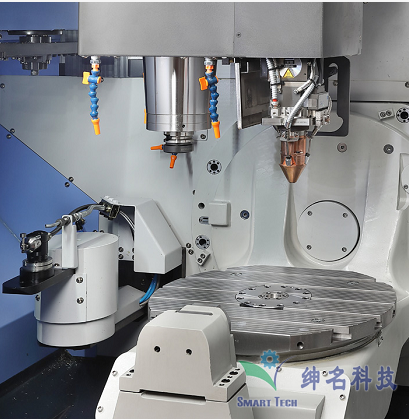
Dean Machine Tools (formerly “Doosan Machine Tools”) first turned its attention to additive manufacturing solutions when a machine equipped with additive‑manufacturing capabilities was showcased on a 5‑axis machining center at EMO 2013. The company subsequently participated in the “Large‑Scale Additive Manufacturing Infrastructure Development Project” hosted by the Advanced Automotive Research Center of the Korea Automotive Technology Institute in 2019, achieving significant results in this field.
04. Dean Machine Tool (formerly “Doosan Machine Tool”)
Possesses a lineup of deposition‑processed products.
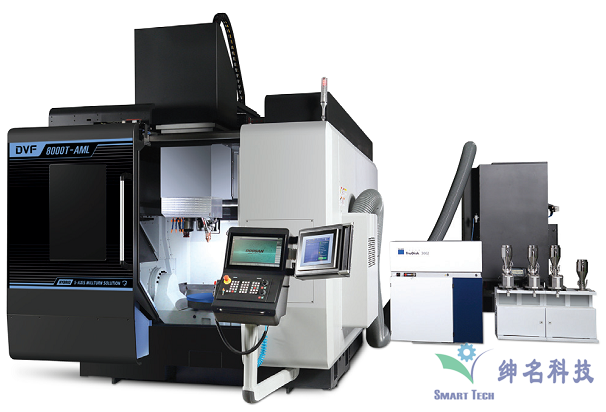
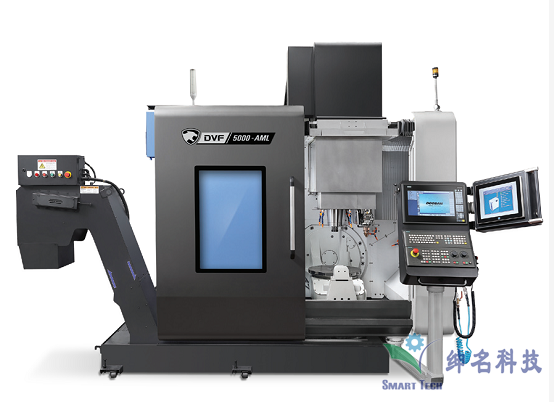
At the DIMF 2021 virtual exhibition hosted by Dean Machine Tools (formerly “Doosan Machine Tools”), the vertical machining center with metal deposition capabilities, the DVF, made its debut. Based on a high-precision, synchronous five-axis machine tool, the DVF series—comprising the DVF 5000‑AML, 8000‑AML, and 8000T‑AML models—includes the DVF 8000T‑AML unit installed at the Yeongam facility. Dean Machine Tools (formerly “Doosan Machine Tools”) aims to spearhead the hybrid machining market with the versatile DVF series, while the VCF 850 LSR model, designed for large workpieces, is also slated for release soon. Meanwhile, the company is developing operator guidelines covering power‑selection strategies and deposition processes, and is advancing advanced solutions for deposition‑monitoring technology.
Dean Machine Tools (formerly “Doosan Machine Tools”) is proactively addressing emerging trends in the era of deep integration—such as “smart equipment,” “smart manufacturing,” and “smart factory” solutions—by continuously elevating its customer service to a professional standard. At the same time, to support customers in diversifying their business areas and tackling complex technical challenges, the company has expanded its portfolio with new solutions and product offerings in the field of deposition processing. Moving forward, in the metalworking sector, Dean aims to become a leading “metalworking platform” that shapes evolving manufacturing trends by developing an even broader range of solutions and product lines.

Leading intelligent manufacturing with five-axis machine, compound machine and high-end equipment
Contact Us
Address: Room Wangjing SOHOT2-1-1606, No.1 Futong East Street, Chaoyang District, Beijing (100102)
Telephone:010-57076158
Fax: 010-57076358
Website:www.beijingsmart.com
E-mail:master@beijingsmart.com

Video Number
Subscription Number
TikTok
Small program