
Dean Machine Tools (formerly “Doosan Machine Tools”) DVF series five-axis vertical machining centers are used in aerospace and other industries.
Dean Machine Tools (formerly “Doosan Machine Tools”) The products have consistently garnered significant attention from customers. In response to industry and customer demands, Dean continuously introduces high‑performance offerings. Taking Dean Machine Tools’ (formerly “Doosan Machine Tools”) five‑axis equipment lineup as an example, the product range is categorized according to axis travel, rotary table size, spindle speed, and other specifications: the FM, DNM, DVF, VC/5AX, and VCF series comprise vertical five‑axis machining centers; the DHF and HFP series are horizontal five‑axis machining centers; and the BM series represents gantry‑type five‑axis machining centers.
Among them, the DVF series of five-axis vertical machining centers is defined by the size of its rotary table. The DVF5000 model is a cradle‑type five‑axis machining center with B‑ and C‑axis rotation, while the DVF6500 and DVF8000 models are cradle‑type five‑axis machining centers featuring A‑ and C‑axis rotation.
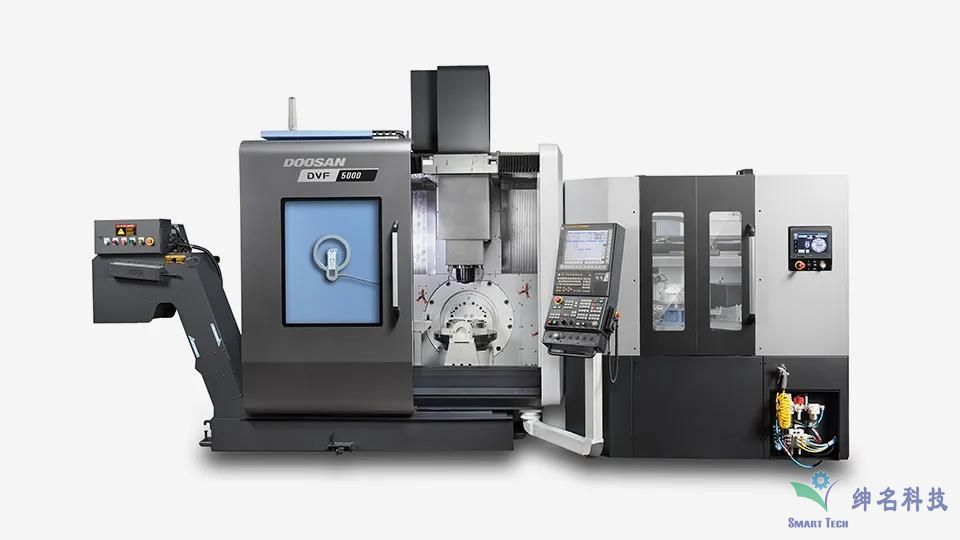
DVF5000 Five-Axis Machining Center The main innovative technologies
The DVF5000 is a high‑productivity, high‑performance five‑axis machining center. Its standard spindle speed is 12,000 rpm (with options for direct‑drive or belt‑drive), while an optional built‑in spindle can reach up to 18,000 rpm. Designed with operator convenience in mind, the machine features a compact footprint of just 2,250 × 2,700 mm (excluding the chip conveyor). It employs an environmentally friendly, full‑lubrication system, and its ergonomically optimized human–machine interface facilitates convenient workpiece loading and machine operation. A compact automated workpiece changer (AWC) can also be added. Furthermore, the DVF5000’s precision has consistently drawn attention, thanks to thermal compensation for both the spindle and the machine structure, as well as standard spindle cooling that minimizes thermal distortion. In addition to these features, the DVF5000 incorporates advanced intelligent dynamic compensation tailored for five‑axis machining: a rotary axis‑centering compensation function reduces part‑shape errors and maintains accuracy during high‑precision operations. It comes equipped with essential five‑axis capabilities, including Doosan’s proprietary DCP‑I software for compensation, a touch probe, and the TS27R automatic tool measurement system. Moreover, it offers optimized automation solutions, such as the AWC (auto‑workpiece change) system for unmanned, automated workpiece handling, along with other comprehensive automation packages.
Parameter advantages of Dean Machine Tools’ (formerly “Doosan Machine Tools”) DVF series products
Taking the DVF5000 series as an example, its worktable can support a load of 400 kg, and it features ATC tool magazines with capacities of 30, 40, 60, 90, and 120 tools. At the same time, the DVF5000 models occupy a smaller footprint. The DVF6500, DVF8000, and DVF8000T series offer several key advantages: their all‑frame‑type structure ensures exceptional stability; they deliver rapid traverse speeds of up to 45 m/min; and their versatile tool magazine configurations—including drum‑style designs and chain‑type systems for 60 or more tools—provide customers with greater flexibility. These machines are equipped with spindle cooling and servo‑axis cooling systems, and both spindles and servo axes come standard with temperature compensation. The DVF6500 and DVF8000 models feature door openings measuring 840 mm and 1000 mm, respectively, facilitating convenient clamping of large workpieces, while maintaining a compact overall footprint. In the aerospace sector, the DVF series is capable of machining components such as door handles for aircraft. Specifically, the DVF6500 has been successfully applied in tire mold manufacturing, processing aluminum workpieces with D3 ball‑nose end mills at a spindle speed of 12,000 rpm and feed rates of up to 3,400 mm/min. In aerospace applications, it can machine three‑piece blisks—engine rotor disks—using titanium alloy, a challenging material prized for its light weight, high strength, and excellent resistance to high temperatures and corrosion, making it a staple in aerospace engineering. Meanwhile, the DVF8000 model is well suited for machining gearboxes and rocket boosters.
The Importance of Five-Axis Machining Centers
The machine tool industry is a barometer of a nation’s manufacturing prowess, and the performance of five-axis CNC machine tools serves as a key industry benchmark. A five-axis machining center can complete the machining of all five surfaces of a workpiece in a single setup. It not only delivers high‑precision machining of complex spatial curved surfaces but also meets the demanding requirements of modern molds used in automotive components, aircraft structural parts, and other applications. As such, it finds extensive use across diverse sectors, including aerospace, mold manufacturing, medical devices, and the automotive industry. Given the stringent performance expectations of industry customers, companies must address these needs effectively and foster long‑term partnerships by focusing on the following key areas:
First, products must undergo rigorous and repeated certification. Take Dean Machine Tools (formerly “Doosan Machine Tools”) as an example: after each new five-axis machining center is developed, it must be subjected to thorough validation by dedicated OSC specialists, who verify the machine’s accuracy through real‑world machining tests and systematically assess its performance—identifying both strengths and weaknesses—and then provide feedback to the R&D team for refinement, thereby ensuring the equipment’s quality and performance.
Second, professional training for operators. Dean Machine Tools (formerly “Doosan Machine Tools”) consistently conducts regular, specialized training for operators of its five-axis vertical machining centers, ensuring that customers can use the equipment with ease. At the same time, the company actively solicits customer feedback to facilitate ongoing performance enhancements.
Third, conduct regular customer follow-ups. Colleagues in the marketing department at Dean Machine Tools (formerly “Doosan Machine Tools”) carry out periodic visits based on real‑world market conditions to assess how customers are using their equipment, gain insights into its actual operating performance, and promptly report back to the company. When asked about his expectations for the future development of five‑axis machining centers, Mr. Su Sheng stated that simplifying machine tool operating systems and user interfaces is the prevailing trend; moreover, advancing toward greater intelligence in five‑axis machining centers has become a key focus for manufacturers. With the continued development of advanced five‑axis machining simulation software, operators will soon be able to simply input a 3D model of the workpiece, and the machine tool will automatically generate optimized machining programs and toolpaths through simulation.

Leading intelligent manufacturing with five-axis machine, compound machine and high-end equipment
Contact Us
Address: Room Wangjing SOHOT2-1-1606, No.1 Futong East Street, Chaoyang District, Beijing (100102)
Telephone:010-57076158
Fax: 010-57076358
Website:www.beijingsmart.com
E-mail:master@beijingsmart.com

Video Number
Subscription Number
TikTok
Small program